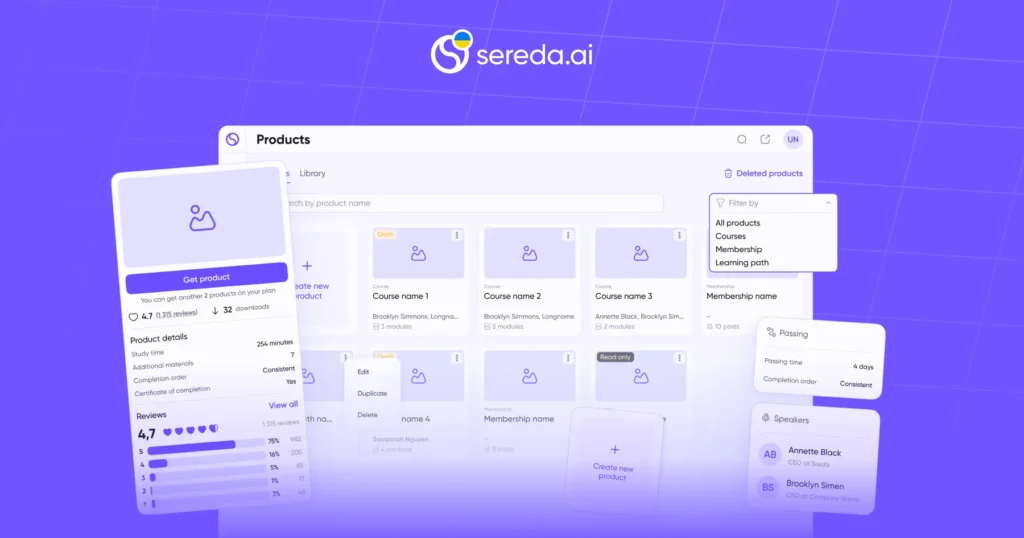
In today’s business landscape, employee training and development have become more crucial than ever. For companies of all sizes — from small startups to international corporations — learning management is no longer optional but a necessary component of growth and success. This is where Learning Management Systems (LMS) come into play. These tools enable businesses to automate, control, and improve the learning process, saving time, resources, and reducing stress.
In this article, we’ll explore what LMS is, the different types of these systems, their use cases, and the main players in the market. We’ll also highlight the benefits of Sereda.ai’s solution — a Ukrainian startup revolutionizing the way businesses manage employee development.
Concepts and Statistics
An LMS is an online platform designed to help companies organize, track, and control the employee training process. Think of it as a corporate university, but without physical classrooms, professors, or traditional long lectures.
According to recent surveys, approximately 83% of companies use LMSs for onboarding and professional development. The LMS market is growing at a 15.6% annual rate, with its value estimated at over $20 billion in 2023. By 2028, it is expected to reach $37 billion. These figures highlight a growing demand for structured, convenient, and automated learning tools.
Types of Learning Management Systems
LMSs are categorized based on business needs and scale. Here are the primary types:
By Hosting:
Cloud-Based LMS: Accessible online, requiring no complex infrastructure, and easily adaptable to any business needs.
Self-Installed LMS: Hosted on company servers and requiring more resources for maintenance.
Open-Source LMS: Ideal for businesses wanting full customization and control over the system.
By Purpose:
Enterprise LMS: Designed for training employees, partners, or customers. These systems help implement new knowledge, enhance skills, and optimize processes.
Academic LMS: Used in educational institutions, offering basic functionalities like lecture delivery and testing but often lacking advanced integrations.
Commercial LMS: These systems are focused on creating and selling online courses. They include monetization features and tools for developing paid content.
Blended LMS: A versatile option for both corporate training and commercial educational projects, blending multiple learning formats in one platform.
Each LMS type has unique strengths, tailored to solve specific challenges for businesses or educational institutions, and can be customized to meet user needs.
What Are LMSs Used For?
Businesses use LMSs to enhance efficiency across various processes. Common applications include:
Onboarding New Employees: Streamline integration into company processes with introductory courses.
Employee Training: Automate skill development to boost team performance.
Change Management: Simplify the rollout of new processes, products, or policies with easy access to up-to-date resources.
Certification and Attestation: Organize exams and provide certificates to validate learning outcomes.
Performance Monitoring: Track individual progress and refine learning paths based on feedback and results.
How to Choose the Right LMS
Selecting an LMS can feel overwhelming, but focusing on key criteria simplifies the decision. Here are some tips:
Ease of Use: The platform should be user-friendly for both administrators and learners, reducing technical barriers to effective training.
Functionality: Choose based on your goals — internal training, commercial courses, or a mix. Each scenario requires different features.
Automation: Look for tools that simplify routine tasks, such as notifications, certification generation, and test grading.
Budget: Evaluate long-term costs, including scalability and optional features.
Scalability: Ensure the platform supports growth without significant additional costs.
Interactivity: Opt for systems with gamified elements, quizzes, and multimedia to keep learners engaged.
Language Support: For multilingual teams, ensure the LMS supports all required interface languages.
Pro Tip: Set up trial lessons to test multiple platforms. Collect feedback from employees to make an informed choice.
Global Market Leaders
The LMS market offers a wide range of solutions. Popular global platforms include SAP Litmos, TalentLMS, Moodle, Absorb LMS, and Docebo. However, let’s spotlight a standout player — Sereda.ai.
Why Choose Sereda.ai?
At Sereda.ai, we go beyond traditional LMS functionalities to deliver a comprehensive Human Capital Management (HCM) platform that integrates seamlessly with your HR processes. Here’s what sets us apart:
Affordability and Flexibility: Adaptive pricing plans suit businesses of all sizes, based on user numbers.
Integrated Solutions: Our platform includes tools for knowledge management, surveys, and performance reviews, creating a unified strategy for employee growth.
Multilingual Interface: Available in Ukrainian, English, Spanish, and Italian, with plans to expand further.
Brand Customization: Tailor the platform with your logo, colors, and branding for a unique user experience.
AI-Powered Assistance: Our AI assistant quickly retrieves answers and resources, streamlining information access.
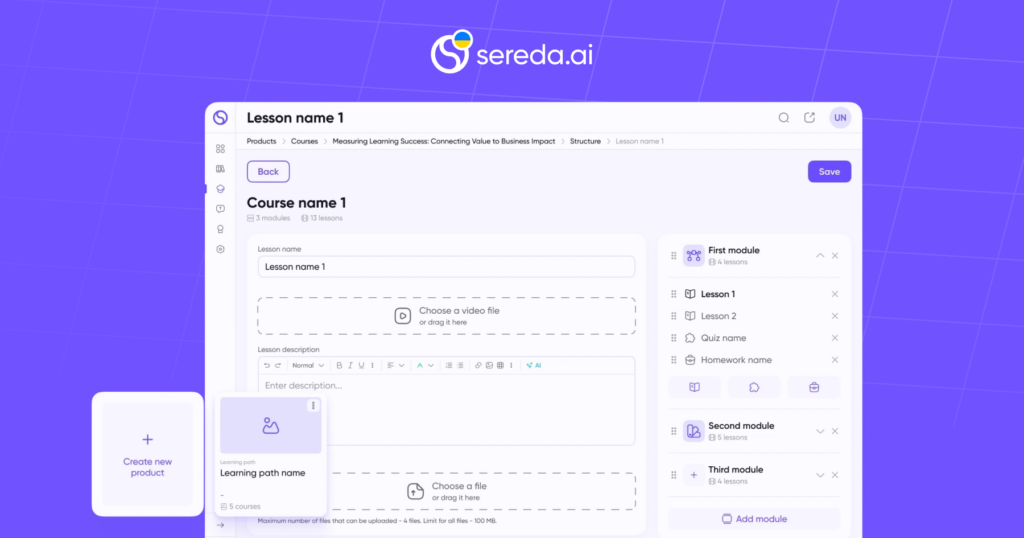
Learning Pathways: Create unlimited courses with logical progression. New stages unlock only after completing prior ones, ensuring structured learning.
Advanced Analytics: Monitor real-time data, gather feedback, and adapt courses as needed.
Implementing an LMS like Sereda.ai transforms your business, enhancing efficiency and unlocking your team’s full potential. Contact us to learn more about our modular platform and start building your custom solution today.